Embracing the Beauty in Others ______(by katie lauve moon)

This week will be Katie Moon's final week as the UBC Office Manager.  Next month she will be moving to New Orleans to begin work on her Ph.D. in Social Work at Tulane University.  Katie and Timmy have been a part of the UBC family for several years and have left an indelible on our community.  They will be greatly missed.  Below are farewell words from Katie... _________________________________

I went to college at Louisiana Tech University.  To many, a Louisiana state school means one thing---trouble.  But if you were a Louisiana native like myself, you would understand that all that trouble happens in the bottom half of the state and that everything grows lily white in the northern half of Louisiana.  You would also know that Louisiana Tech (of the north) thrives in the richness of the great Bible Belt in a dry town called Ruston. Now, Ruston is a safe place where good ole boys, Protestants, and Republicans can all live on forever finding their family, friends, and purpose all in one place—First, Second, or Third Baptist Church right down the road. This is where I spent four years of my life. This is where I began to build the adult version of myself. This is the environment that welcomed and guided me as I entered into arguably a person’s most transformative time of life.  And I loved it.

I loved that I was surrounded by a group of people that was concerned with my spiritual journey. I loved that they cared enough about me to give me an accountability partner, feed me lunch on Tuesdays, and call when I missed a Sunday. I had my own little world safe and separate from the big, scary college world. It was very similar to the youth group I came from. It was home away from home.

But then I turned 21 [insert dramatic music that indicates a shift in theme]. Now readers, I think we can all call a hen, a hen here and not be so naïve to think that I didn’t drink alcohol before my 21st birthday. Of course, I did. But I did most of my drinking in the closet next to my shoes. And when I say in the closet, I mean with my sorority sisters outside city limits far away from my friends at the Baptist Collegiate Ministry (BCM). Now, I didn’t do it without guilt. A whole lot of guilt and begging for forgiveness from God, and confessing. Well, not a whole lot of confessing.  I did confess it to my college minister and accountability partner one time, and then I was under constant surveillance for the next 3 months (I think that is the standard amount of time it takes to get the devil out of you). That was the last time I did that.

When I turned 21 though, I became more open about my casual drinks and my “community” became more open about their disdain for my choices.  I was still “welcomed” but I was on the fringe.  To be real honest, my heathen sorority sisters gave me more love and grace than I ever found at the BCM (with a few exceptions). Point being, I found that most of my friends at church only accepted me if I agreed to fit into the acceptable mold that they had created and that the generation before had created for them. I was backed into a corner forced to choose between two groups, two lives, two perspectives. It was a black or white issue.  And what did I do? Well, I chose my church group, of course. Did you think I would risk my eternity for authentic friendships? Nope. I stepped right into that mold and shut the door. Misery now, but paradise tomorrow.

The next natural step for me was to answer my call on my life and go to seminary.  Perhaps, I initially chose to go to seminary because of the urgings of people around me.  But really, that wasn’t the reason.  A voice within me (within me, not a literal one), told me there was more for me to discover about this universe and about God, and this discovery began in seminary.  I came to Truett not knowing much about it.  I actually came to Truett because it offered a dual degree social work program not because I knew it would offer me a totally new way of learning about and experiencing God. But it was here that walls crumbled and doors opened for me. For the first time, I was being taught how to think not what to think. There were so many opinions and perspectives all under one roof…and it was okay. Welcomed, even.  I began to discern my thoughts and feelings about my college experience. The trouble wasn’t that I disagreed with my college folks’ perspective, the trouble was that there was only one perspective that I could choose to agree with. Where were my options? Was it absurd to think that there could be (should be) more? Couldn’t we see things differently, and still all be Christians at the end of the day? I found that it’s not about whether we are liberals or fundamentalists, drinkers or non-drinkers, Republicans or Democrats, country singers or rap idols—it’s that we agree to make room for all of us and at least try to understand and sympathize with each other’s viewpoints. Let’s create a little bit of gray.

This lesson I learned at Truett came to fruition in my time here at UBC.  Because of the acceptance and grace UBC offers, I was able to experience community in a very intimate and authentic way. UBC truly became a home filled with love and support as well as a solace for different opinions, approaches, and even shortcomings. I was allowed to become the most authentic and honest version of myself at UBC and be given the invaluable gift of freedom.  As a congregant, student, and staffer at UBC, I have gotten to see and experience what it is to love others and be loved wholly.  My husband, Timmy, and I will be eternally grateful for our experience here.  The friendships we have made and the approach to life and community we have experienced will always be kept in the pocket closest to our hearts. Always ready and handy to be taken out and shown to others we meet as we journey forward.

As we say good-bye to this community, I am reminded of a sermon I heard in college from 1 Corinthians 12 which speaks about unity and diversity within the church’s body.  The lesson I learned that day was that we all have tangible and different gifts that we offer as members of the body of Christ.  We all need each other because we all offer a valuable function to the community.  I don’t doubt that this is true.  But, (admittedly, this is without reverting to commentaries-forgive me) I now have to believe that this passage is referring to more than just the tangible elements we have to offer. It’s not only our different tangible gifts and functions that make the body the body, but our intangible and diversified collection of souls.  And with this comes our call to embrace others fully and wholly.

“But God has put the body together, giving greater honor to the parts that lacked it, 25 so that there should be no division in the body, but that its parts should have equal concern for each other. 26 If one part suffers, every part suffers with it; if one part is honored, every part rejoices with it.” 1 Cor. 12:25-26

UBC. May you always be a community that embraces the beauty in others.
Musical Boxing: Art vs. Accessibility _(by tye barrett)

A few weeks ago I was hired by Ubc to be the new Worship and Arts Pastor.  The title “Worship and Arts Pastor” excites me, in part because it sounds way cooler than “Minister of Music”, but also because I know that I am a part of a community that values creativity and the act of being creative in our worship. About a year after Dave had moved to Atlanta, the Leadership Team began meeting to discern what music, worship, and art would be like in Dave’s absence.  The Leadership Team felt that it was important for our church to continue to celebrate art and using art in worship with the same careful and thoughtful attitude that Dave worked so hard to foster here. Thus, Worship and Art.

Occasionally, the way we use art and our creativity in worship can be challenging.  This challenge can be easily perceived when overhearing someone say, “The music was really artistic, but it just was not accessible.” Accessible may mean several different things to the person making this statement- that they didn’t have the spiritual experience they sought, they didn’t prefer that style of music, that it was too fast or slow, too loud or soft, or perhaps that they weren’t familiar enough with the words to sing along. Many times I think it can mean that the worship just made them feel uncomfortable. There is a need for us to be creative in worship, but also a need for the congregation to connect with what is going on.

Below you will find Round 1 of a two-part match between art and accessibility.

………………………………………………………………………

In the left corner: at 119 pounds, in plastic black framed glasses, vintage T-shirt, clove cigarettes, no money, and a weird beret…Art.

And in the right corner: at 130 pounds, with a minivan, Starbucks, KLOVE radio, and a Target gift card…Accessibility.

Round 1- Trying to be Radiohead

DING

Circa 2010 I thought that most Christian bands sucked and that they didn’t work hard enough to be artistic.  On a muggy summer night in Houston, I, critic extraordinaire, had the chance to prove once and for all that Christian music can in fact be creative.  Below is the account of this heroic tale.

I was really fortunate to have a roommate as cool as Griffin Kelp.  Griffin is one cool dude. His beard grooms itself, he looks good in Wayfarers, and he is comfortable in his own skin. Griffin also makes very cool music.

So, when my friend Kyle Wilson, a youth minister at UBC Houston, gave me a call and asked if I could put together a band for an event he was having at his church I quickly said yes and then quickly called Griffin. Being the ever-nice guy that he is, Griffin agreed and we quickly went to work. I worked hard to pick out songs for our band that I thought were artistic, the type of songs one would associate with guys that looked as cool as Griffin.  We learned Radiohead’s All I Need, Crazy by Seth Woods (aka the Whiskey Priest) and a few more awesomely obscure slightly spiritual tunes.  We made loops, came up with interesting guitar parts, and worked hard to create a unique sound. Our efforts produced a band that what I, and probably many of you, would consider artistic.

Kyle asked us to play as the students walked in. The lights were dark, we were rocking, and in they came. After the first song the lights in the room came up.  I looked out across the room and noticed that there were only about four people in the room over the age of twelve.  These students were not just kids, but Kids. Turns out we were playing for a group of soon to be sixth graders who were about to matriculate into Kyle’s youth ministry. It became immediately apparent in the wide eyes of these children that our artistic approach was not going over well. We painfully made our way through a twenty-minute set.

Even though the worship set that Griffin and I had played that first night was intentionally artistic and creative, it failed to connect with the students of Kyle’s ministry.  In our desire to be artistic we left these young minds with the impression that a worship service is a time for a band to get up and experiment while they look at lyrics on a screen. We failed to me the needs of those we were trying to serve. Before we played the next day, we quickly learned a few songs that were more appropriate for the students that Kyle had brought us in to play for.

Like that night in Houston, there are times when our efforts to be creative backfire. Sometimes we work so hard to be unique, to push ourselves artistically, and to experiment with new sounds and textures that we fail to meet the needs of our congregation. I wish Griffin and my experience in Houston was an isolated incident, but every now and then I look out into the congregation and see something in the eyes of twenty and thirty year olds that reminds me of what I once saw in a group of twelve year olds.  As we at Ubc continue to value art and creativity in worship, it is important for us to keep moments like the one I had in Houston in mind.

Well after a few good swings it looks like round one goes to Accessibility.  Don’t go anywhere folks, we’ll be back after a short break with Round 2:  Not Wanting to be Nickleback.

The Cumulative Nature of Corporate Worship (by craig nash)

The church I attended as a child and teenager was (and is) firmly rooted in the tradition of 20th century revivalism.  Every part of the Sunday morning worship service pointed to one event-- The altar call.  The majority of hymns centered around giving (or re-giving) our lives to Jesus.  Sermons were about conversion and rededication.  If someone missed church for whatever reason, the questions they asked about the service inevitably centered around a version of "Did anyone 'walk the aisle'?"  (Other variations of this question were "How many decisions were made," "Who 'went forward' this morning," or "Did anyone get saved?") The first church I was a part of after graduating from high school was influenced by the neo-charismatic tradition.  The "altar call" was also the central aspect of the worship services at this church, but it took on a different significance than conversion or the making-of-a-decision. For one, although there was a specific time dedicated to "coming forward," we certainly weren't limited by that portion of the service to come forward-- we could do it anytime.  (The really spiritual and "broken" people (which was considered a good thing) actually came forward at the most unorthodox times.)  But mostly, the difference was this:  Going to the altar was less about making a decision and more about allowing the Holy Spirit to do "work in your heart."  (To be fair, the revivalist services of my childhood also allowed for the Holy Spirit, but the main point was "the decision.")  In fact, every part of the service was about the Spirit's effect on our lives and, more specifically, on the moment we were in.  The questions asked of these services was "Did God do anything big today," or "Did the Spirit move?"

Other churches I have been a part of have focused more on the mind.  Cognitive acquisition of facts about the Bible  was of primary importance.  To be sure, the goal was to make a decision, and the Holy Spirit was an influence on what was happening, but folks usually left these services saying "I learned so much today!"  The songs were highly doctrinal and the sermons came complete with a fill-in-the-blank outline.  Sunday Worship was God's School.  The idea was that if we just got all our facts straight, and responded to God based on these orthodox beliefs we had acquired, then "true worship" had occurred.

And then there were the churches and ministries affected by the "Passion Movement."  Infused with the theology of John Piper, worship services became all about God's Glory.  The idea is that corporate worship, like real-life discipleship, is solely about self-decrease and God-increase.  Phrases like "God's fame and renown" and "my unworthiness" were the operative buzzwords of song and sermon.  There were decisions made, the Holy Spirit moved, and information was disseminated, but each of these were in service to the elevation of God and de-elevation of ourselves.  "Was God glorified?" became the question de jour about these worship services.

These all represent very important streams of Christian thought and are essential elements to the life of any worshipping community, along with many traditions that I have not mentioned.  But there is a fatal flaw in each of these manifestations of Christian Worship:  There is too much expectation wrapped into every Sunday morning for something to happen.  We create mental checklists of success and require a "C" average, at worst.  If we fail one or two Sundays at checking off the required boxes, that is ok, we'll work harder the next week to make everything come out ok.  If on the third or fourth Sunday we don't have any salvations or the Holy Spirit doesn't "fall" or the sermon doesn't "resonate with us," then we start to sense something is wrong.  By the fifth Sunday a meeting is held of the church leadership to see what needs to be done.

All of this perpetuates (and is perpetuated by) a very nearsighted view of Christian community that sees the life of Corporate Worship as nothing more than a series of disconnected events, productions really, that need to be "successful."

This has also created a multiplicity of churches designed solely to resonate with a particular demographic of people, beliefs or leanings.  Churches now are formed (in the Bible Belt, anyway) based on what "resonates" with a group that does not find resonance elsewhere.  If you want to go to a church that has numerous weekly conversions and baptisms, I've go the church for you.  Looking for a church where the Holy Spirit moves?  I've know the perfect place for you to be.  Want doctrine, missions, artistic worship, God's fame?  Go here, here, here or here.

(Don't think I have missed the irony of me, a pastor at UNIVERSITY Baptist Church, writing such things.)

I think the difficulty here is one of perspective. Namely, a perspective of time.  This is especially poignant in a college town like ours where every fall we ask students to visit around a few churches, "give them a look," and decide which is the "right place" for you.  As if you could possibly discern the heart of a church in a couple of visits.

This places incredible burden on churches to "put on a good show" for new people. (And old ones as well.)

In the role I play in leading our worship services at UBC, my hope is that something is created that is not a show meant to get decisions, feelings, knowledge-acquisition, etc. (though these are all important.)  My hope is that we, as a worshipping community, can repeat the Words of Life so often that slowly, over time, we start to believe them.  And eventually, with much grace, that we begin to live them.

Words matter.

"This is the Word of the Lord-- Thanks be to God!"

"Christ has died, Christ is Risen, and Christ will come again!"

"As we approach this week, may we love God, embrace beauty, and live life to the fullest."

The reality is that worship never simply happens in a service, it happens in a life.  And, more specifically, it happens over a lifetime.  And even more specifically, it happens over all the lifetimes of individuals that make up a community of faith.  As we speak and sing the words that matter, we become a worshipping community.

Wendell Berry tells a story about an old bucket hanging on a fencerow of the property his family has lived on for generations.  On one of his daily walks he noticed something peculiar happening-- soil was being created in the bottom of the bucket.  Leaves had fallen in the bucket, as had snow and rain.  Birds had left their droppings and squirrels had hidden nuts.  The moisture from the rain has rotted the materials in the bucket.  These processes have happened and repeated themselves for decades, producing a thick, life giving layer of fresh soil at the bottom of the bucket.  Berry says...

However small a landmark the old bucket is, it is not trivial. It is one of the signs by which I know my country and myself. And to me it is irresistibly suggestive in the way it collects leaves and other woodland sheddings as they fall through time. It collects stories too as they fall through time. It is irresistibly metaphorical. It is doing in a passive way what a human community must do actively and thoughtfully. A human community too must collect leaves and stories, and turn them into an account. It must build soil, and build that memory of itself—in lore and story and song—which will be its culture.

This accumulation is what happens in Corporate Worship.  On most Sundays something small lands in our bucket.  But not always-- There are extended periods of drought and inactivity.  Occasionally a significant collection of raw materials finds its way into the bucket and on rare occasions, (maybe a handful of times in a decade?,) manna from heaven falls and it is undeniable that something important has happened.  All of these collected materials are important, but none are more important than the lifetime of accumulation that they have brought about.

So when someone asks a question like "What can I expect to experience when I attend one of your worship services," I am inclined to reply-- I'm not sure.  Ask me at the end of my life, and I might have a somewhat decent answer for you.  In the meantime, why don't you come worship with us.  Stick around for a few decades and after singing, hearing and reciting together that ancient, magnificent story in the midst births and deaths, periods of conflict and moments of peace, days of joy and nights of grief, maybe then we will have a reply for each other.

But until then, let us sing...

Church Beyond UBC...

Because of the historically transitory nature of our church (read: we have tons of college students,) this is the time of the year when we experience both the joy and the sadness at saying "goodbye."  Although we have seen an increase in the amount of graduates sticking around Waco and UBC when they begin their careers or continue their education, we still have a large segment of students leaving us as they move on to different cities and towns, all over the world.  This weekend in our worship service we will recognize them, show them a video about Mr. Rogers, and commission them to do the work of Christ in whatever place and profession they find themselves in next.  It will be a time of tears and a time of excitement about what is next. For numerous reasons these students have found a place of rest, home and Christian community at UBC.  Some have poured their lives into small groups and Bible Studies, some have made tremendous sacrifices of their time and resources to worship and do life with us.  Still others were a part of us from a distance.  We were the "last chance" at faith for many of them and they simply needed a place to breathe and to ease themselves into the life of worship from the periphery.  We consider all of these, those we know well and those who are only friendly, familiar faces on Sunday mornings, to be part of us, and we pray the next step in their journey is a meaningful one that finds them a few steps closer on a journey toward Christ.

One of the things we often hear from our graduates once they move on is how difficult it is to find a community of faith to worship with in the new places they find themselves in.  Sometimes they find a place that "will do," as they continually to seek a place that is more like UBC.  Other times they give up altogether, reckoning that they will never again find a church that resonated with them in the same way UBC has.  We do not want either of these to happen.  We believe that faith in Christ is best lived out in the midst of other believers who have committed themselves to worship, prayer and the proclamation of Scripture.  Meaningful Christian faith has always been done in the midst of community, and we pray that our graduates find that community.

With this in mind, we would like to offer a few suggestions to help you along in the next step of your journey...

1.  UBC is a very diverse place.  Socially, theologically (how we think about God,) ecclesiologically (how we think about church,) soteriologically (how we think about salvation,) we are ALL OVER the map.  Sure, there is a general trajectory that most at UBC find themselves on, but that trajectory has room for a lot of people.  We have hand raisers and stoics; Calvinists, Arminians and Open Theists; those who would never considering drinking alcohol and those who would never consider not occasionally drinking alcohol; Republicans, Democrats, Libertarians, even anarchists; Pacifists and Just War proponents;  And the list goes on and on.

A couple of things about this.  First, don't become anxious if you don't find a place that is diverse as we are.  While there are definitely churches out there, the general feeling of many churches is that there needs to be a rallying around of specifically agreed upon principles that participants should give ascent to before they become members in good standing.  This is not necessarily a bad thing.  (In fact, it can sometimes be a very good thing.)

Second, think about 2-3 elements of UBC that are especially meaningful to you, and move in those directions as you begin to think about new churches.  For example, you may find a place that has similar teaching, puts a high premium on community and social action, but whose musical worship styles are vastly different from ours.  Don't let this prevent you from worshiping with a church that is a good fit in every other way.  Similarly, you may find everything else is meaningful to you, but the teaching may really rub you wrong.  Don't let this necessarily be a deal breaker for you.  To be sure, there may be teaching that is so far out of the realm of Scripture and Christian tradition that should keep you away from a church.  But it could also be that you are simply hearing a different perspective on the gospel that you haven't heard before.

In short, be wise in choosing another church.  Feelings are important, but don't make a decision based solely on feelings. Reasoning is important, but don't make a decision based solely on reason.  Begin praying now that you will find a community of faith, knowing that there is no perfect place.

2.  Look for a place to serve.  Being in such a "Christian" place as Waco, with the world's largest Baptist university just a few blocks away, most churches do not lack for people to do the work of the church.  In our own church, there are people on just about every row who could preach, lead worship or a Sunday School class, organize an event or provide very important pastoral care for the people in the church.  However, this is not the norm.  The vast majority of churches in this world are PRAYING FOR YOU RIGHT NOW to come their way and to give yourselves in service to them in a sacrificial way, and for them to be able to love you as their own.  Be on the lookout for these places.

3.  Find a church close to you.  All too often we hear about that church forty miles away in which "God is doing some great things" and we want to see "what is going on there."  While it isn't unhelpful to visit these places, it is more important that you can be in a place where you at least have some chance of interaction with the congregants OUTSIDE OF CHURCH.  You are more likely make a church home (and it will be better for your stress level) if you find a place that isn't a "Church on Display for the world to see," but a "Church that is quietly doing the work of Christ in your very neighborhood."

4.  Three tangible resources in finding a church--

  • Although "emerging church" is a term that is so broad and elusive that it is hard to sometimes describe what it means, UBC can be described, at the very least, as a church that has the fingerprints of that movement all over our history.  We are by no means forerunners of "emerging thought," and many would even question us falling under that umbrella, but we certainly identify with many of the churches whose trajectory of faith has been influenced by that tradition.  As you begin to look for a church, this may be helpful knowledge for you as you begin to navigate terminology.
  • UBC is affiliated with The Cooperative Baptist Fellowship.  The CBF is a very diverse collection  of historically Baptist churches that work together in an effort to be the presence of Christ in the world.  While we are certainly unique among CBF churches, most of them share our desire for authenticity, generous orthodoxy and authentic community that seeks to transform believers into the image of Christ.  Here is a "Find a Church" page on their website that is very helpful.  
  • Between the full-time and part-time staff of UBC, as well as dozens of more people in leadership positions, we have connections literally all over the world and would love to help put you in contact with a church that we may have relationships with in your new town.  If you would like us to help with this, email craig@ubcwaco.org, let me know what town you are heading to and we will do our best to find you a list of options.

Remember that we are praying for you to find a meaningful community of believers to share the next steps of your journey with!

Baptism at UBC...

At UBC, baptism is special.

To be sure, it is special for all who follow the way of Jesus.  Baptism is the marker, the statement we make to tell ourselves, each other and the world "I am identifying myself with Jesus Christ, the Son of God, and choosing to follow after him.  I am handing my entire life to God to do with it whatever God chooses."  We baptize because Jesus was baptized.  We baptize because John the Baptist and Peter and numerous saints along the way have preached "Repent and be baptized!"  In baptism we go under the water, remembering that one day, in death, we will be placed into the ground.  We go under the water also remembering that we are sinking in our sins.  We come out of the water in anticipation of being raised out of the ground, and in recognition of our great need to be raised out of the torrent of sin.

And for us, baptism has taken extra significance.  In 2005, as our friend and pastor Kyle Lake prepared to baptize a member of our congregation, a series of malfunctions occurred and he passed away.  It was a horrific day, a day in which the brokenness of the world was made manifest before our eyes, a tragedy that we have been marked by.  But can I be so bold to say that something beautiful happened that day as well?  In those waters-- waters that represent the passing from  temporary, sin-filled and self-obsessed life, to death, to eternal life with our Creator-- our friend passed from life in this broken world to life in a complete, eternal world.

The sting of death was very real and present on that day, but because of the picture baptism paints for us, we remember that death does not have the final say, Jesus does.  This story is ever present with us when we come to the waters of baptism.

Since that day we have moved baptisms from our building to the outdoors.  We offer up Palm Sunday of every year-- the day Christians celebrate Jesus' entrance into Jerusalem to defeat death once-and-for-all-- as the day for those who have not yet been baptized to do so.

If you would like to be baptized on that day, please let us know.  Any of the pastors at UBC would be overjoyed to baptize you.  If there is someone special in the church who you would like to baptize you (Mi Casa leader, Sunday School Teacher, Parent, etc.), we encourage that as well.

If you are interested, please email craig@ubcwaco.org before Wednesday, March 28th.


Via Crucis...

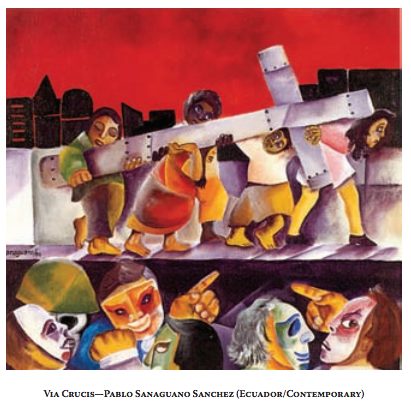
In the first week's selections for Devotions for Lent, you'll notice a painting by Pablo Sanchez.  The title of the painting is Via Crucis which translates as "The way of the cross."  It is a fitting visual to begin a forty day journey with Jesus into the wilderness because all true discipleship consists of walking the way of Jesus, which just so happens to be the way of suffering. At the end of the book of Mark, there is a scene that illustrates this well.  (Many scholars believe Mark actually ends in 16:8, and that the rest was added in an attempt to "clean things up" a bit.)  On that first Easter Sunday the women who had stayed with Jesus until the end made their way to the tomb only to discover a messenger who announced to them that Jesus had risen.  He gave them the instruction to tell the disciples to go to Galilee, where Jesus had already gone ahead to meet them.  The final verse is telling... Mark 16:8: "And they went out and fled from the tomb, for trembling and astonishment had seized them, and they said nothing to anyone, for they were afraid."

What a way to end a gospel!

"They were afraid."

After hearing that Jesus had risen, why was fear present?  Maybe the answer lies not in the resurrection, but in the final instructions-- Go to Galilee, where Jesus will meet you.

Galilee.  The place where the ministry of Jesus began. The place that set Jesus onto the road toward the cross.  The beginning point of suffering.  The way of Jesus may end in resurrection (thanks be to God it does,) but it begins on a journey to the cross.

Take a few moments to look over Sanchez's painting and reflect on the following questions...

1.  What do you notice about the people carrying the cross?

2. Where do you find yourself in this painting?  Where do you want to find yourself in this painting?

3.  In Waco we live in a culture in which it might cause more suffering, shame and ridicule if you aren't a Christian than if you are.  What does the "way of the cross" look like to those in Waco, TX?

4.  What else do you see in this painting that speaks to you about discipleship and being formed in the image of Jesus?

Please share your thoughts in the comments section...

Reading for Transformation...

First of all, we have received a large shipment of the Devotions for Lent booklets.  We will have them at the church for you to pick up for $3, beginning tomorrow morning. A few words on "Reading for Transformation..."

________________

Most reading we do is either for information or recreation.  With informational reading the goal is to receive data, facts and ideas and to churn them around our brains until the end result is knowledge.  

Recreational reading seeks to help the reader escape.  Though the acquisition of knowledge may occur, the main purpose isn't knowledge, but enjoyment.  (In a similar way, informational reading can also be enjoyable, even though that isn't the primary goal.)

When we read the Bible and other Christian writings, the acquisition of information and enjoyment are certainly things that occur, but neither should be the main point.  Instead, our prayer should always be that in devotional reading we are being transformed.  This means that God, through our engagement with the words on the page, is turning us into a different person after the reading than we were before the reading.  The change that occurs within us may be monumental and instantaneous, but is most often incremental and gradual.

A key component of this is that we remain engaged with what we are reading.  Remember, the Bible was written, and for centuries was received, in an oral culture.  For the majority of Christian history, where very few people were literate, Scripture and devotional reading was heard, not read.

When we read things, our eyes can always scan back over the words as we seek to master what is written.  But when we hear things those parts of our minds that imagine and intuit are awakened through engagement with the text.  And only when our imaginations are quickened and we envision what our lives can be, are we transformed.

As you read the selections in Devotions for Lent, and as you read Scripture and any other spiritual material, go into the experience expecting to be changed.  Engage with the text.  Wrestle with it. Reread it slowly.  Reread it quickly.  Live it.

________

If you have time, there is a perfect example of what engaging with the text and reading Scripture  imaginatively may look like, check out THE FEBRUARY 23rd sermon from Truett's chapel  by our friend Robert Creech...

"Devotions for Lent"-- Week 1

Sunday February 26, 2012 The Devotions for Lent booklets are coming in slower than we had expected.  This morning we will have a few copies for those who have $3.  The rest should be coming in early this week.  No worries, though, for the publisher has placed the first weeks readings, art and reflection online in a pdf. format.  You can access it HERE...

A few words on how to read the devotions--

1.  There is a list of weekly readings on the first page.  At the end of the booklet are the complete verses.  Spend time each day reading one of the selections.

2.  You'll notice that there isn't a clear "flow" to each week.  This is intentional.  The goal isn't to get to the end of the week having checked off every little item, but rather to have spent time intentionally reading the Scriptures, praying the prayers, and reflecting on the artwork.

3.  Don't read so much for information but rather for transformation.  More on this later.

Be on the lookout this week on this blog for reflection questions.